
Understanding the healthcare system can be overwhelming, and it is the cost most retirement plans underestimate. Whether you are retiring before Medicare, sorting through Part B and Part D, or worrying about what a few years in care would do to your savings, the goal here is the same: clear options and a decision you understand.
Why healthcare planning belongs in your retirement plan
Healthcare is the retirement expense people most often underestimate. Premiums, deductibles, prescriptions, dental and vision care, and the possibility of long-term care can add up to a large share of retirement spending. Healthcare planning turns those unknowns into numbers you can put in the plan.
Our healthcare planning is advice first: explaining your options, pricing them, and building the cost into your income and investment plan so a coverage decision does not become a surprise. Jason is also a licensed insurance agent who sells Medicare Supplement (Medigap) insurance, so when a supplement is the right answer you can arrange it here rather than starting over with a stranger.
Retiring before 65: bridging the gap to Medicare
If you stop working before Medicare begins at 65, you need coverage for the years in between. Common options are COBRA continuation from your employer, a spouse's employer plan, or an individual plan from the Health Insurance Marketplace at HealthCare.gov, where premium tax credits depend on your income. Because those credits are income-based, how you draw retirement income in those years can directly change what you pay.
Medicare enrollment without the penalties
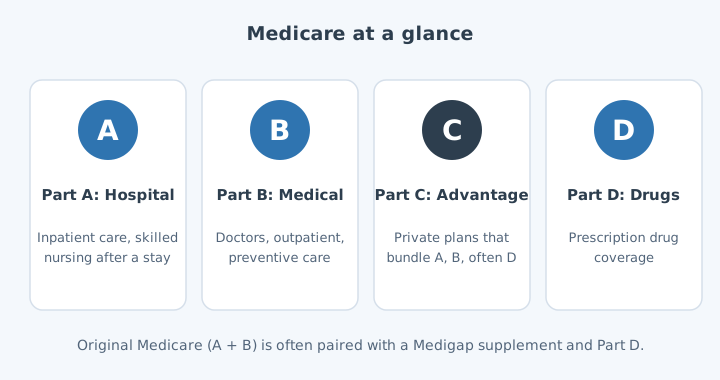
Medicare has four main parts: Part A for hospital care, Part B for doctor and outpatient care, Part D for prescription drugs, and Part C, known as Medicare Advantage, which bundles coverage through a private plan. Many people pair Original Medicare with a Medigap supplement instead.
Medicare Supplement (Medigap) plans
A Medicare Supplement policy is private insurance that pays some of the costs Original Medicare leaves to you, such as the Part A deductible and the 20 percent Part B coinsurance. Plans are standardized by letter, so a Plan G from one insurer covers the same things as a Plan G from another; what differs is the premium and how the insurer has raised rates over time. Jason is licensed to sell Medicare Supplement insurance and can quote the carriers available to you in Florida, help you apply, and remain your agent for service questions. If you buy a plan through us, the insurer pays us a commission, which we disclose before you decide. The best time to buy is usually your Medigap open enrollment period, the six months after your Part B starts, when an insurer cannot refuse you or charge more because of your health. Medicare Supplement plans do not include prescription drug coverage, so most people pair them with a stand-alone Part D plan. Not connected with or endorsed by the U.S. Government or the federal Medicare program.
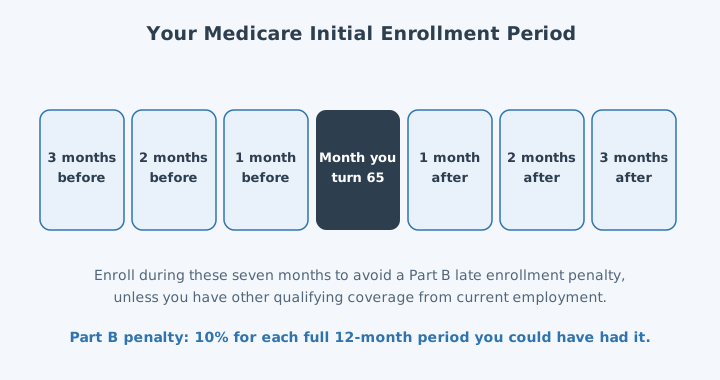
Your Initial Enrollment Period is seven months: the three months before the month you turn 65, that month, and the three months after. If you do not sign up for Part B when you are first eligible and do not have other qualifying coverage, such as an employer plan from current work, you may pay a late enrollment penalty of 10 percent for each full 12-month period you could have had it, for as long as you have Part B. Medicare.gov has the official details.
The income-related surcharge
Higher-income households pay more for Part B and Part D through the income-related monthly adjustment amount, often called IRMAA. It is based on your income from two years earlier, so a large Roth conversion or the sale of a property can raise your premiums two years later. We time those decisions with that in mind.
Planning for long-term care
Medicare generally does not pay for long-term custodial care, the everyday help with bathing, dressing, and eating that many people eventually need at home or in a facility. That makes long-term care one of the largest financial risks in retirement.
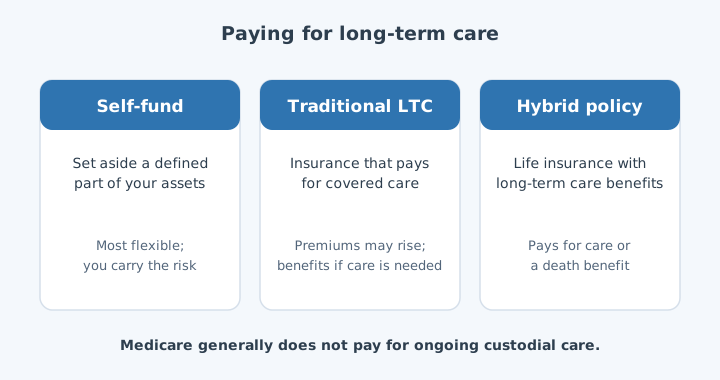
The main approaches are self-funding a defined portion of your assets, traditional long-term care insurance, and hybrid policies that combine life insurance with long-term care benefits. We compare the real costs for Northeast Florida and help you choose the trade-off. If you buy an insurance product through us, the insurer pays us a commission, which we disclose before you decide.
Health savings accounts and veterans' benefits
If you have a high-deductible health plan, a health savings account lets you contribute pre-tax, grow tax-free, and withdraw tax-free for qualified medical costs. Once you enroll in Medicare you can no longer contribute, so the timing matters.
Veterans and military retirees have additional options. VA healthcare may cover some or all of your care, and military retirees who want TRICARE For Life must enroll in Medicare Parts A and B. As a veteran himself, Jason walks through how these pieces fit together.
Healthcare planning in Jacksonville
We put your coverage decisions, key dates, and contacts in writing so they do not live in one person's memory. Healthcare planning connects directly to income planning and legacy planning, and your first visit is complimentary.
Who this is for
You might recognise yourself here
You want to retire before 65
The gap between leaving employer coverage and becoming Medicare-eligible is one of the most expensive stretches in retirement — and one of the most plannable.
You are approaching Medicare enrollment
Original Medicare plus a Medicare Supplement, or Medicare Advantage. We explain the difference, and if a supplement fits, Jason can quote and write it for you. Miss an enrollment window and the penalty follows you for life.
You watched a parent need care
You have seen what it costs and what it does to a family, and you do not want your children making those calls without a plan.
What we do
How this works in practice
No jargon, no black box. Here is the actual work.
-
Bridge the pre-65 gap
We price out marketplace coverage, COBRA, and a spouse's plan, then build the cost into the income plan so early retirement is a decision rather than a surprise.
-
Walk through Medicare, plainly
What Parts A, B, C, and D actually cover, what a supplement does, when you must enroll, and what the late-enrollment penalties look like.
-
Quote and set up a Medicare Supplement
Jason is a licensed insurance agent and sells Medicare Supplement (Medigap) insurance. If a supplement is the right fit, we compare the standardized plans and carriers' premiums, help you apply, and stay your agent afterwards. The insurer pays us a commission, which we tell you before you decide.
-
Watch the income-related surcharge
Medicare premiums rise with income from two years earlier. A large Roth conversion or a property sale can quietly raise your premiums — so we time them.
-
Plan for long-term care
Insurance, hybrid policies, or self-funding a defined portion of your assets. We show the real numbers for Northeast Florida and let you choose the trade-off.
-
Put it in writing
Coverage decisions, key dates, and who to call — so it is not living in one person's memory.
How it fits your bigger plan
One piece of a single plan
Healthcare is where retirement plans quietly break. A single long-term care event can consume savings meant to last two lifetimes, and pre-65 premiums can delay retirement by years. Planning for it protects the income plan and the legacy plan at the same time.
See the comprehensive plan
Your planner
Jason French, MBA
Founder and lead advisor of French Capital Management. A disabled combat veteran and former Merrill Lynch and Edward Jones advisor, Jason now works as an independent fiduciary for families in Jacksonville and across Northeast Florida.
Meet JasonQuestions
Common questions about Healthcare Planning
How much should I budget for healthcare in retirement?
It varies widely with coverage, health, and whether you retire before 65. Rather than quoting a national average, we build the number from your actual coverage options and your household's health history.
Original Medicare with a supplement, or Medicare Advantage?
It is a genuine trade-off between predictable costs and broad provider access on one side, and lower premiums with a network on the other. Your doctors, your prescriptions, and how much you travel usually decide it.
Do I need long-term care insurance?
Not everyone does. If your assets are large enough, self-funding a defined portion can be reasonable. If a care event would force your spouse to change their life, insurance or a hybrid policy is worth pricing out.
Do you sell insurance?
Yes, where it belongs in the plan. Jason is a licensed insurance agent and sells Medicare Supplement (Medigap) insurance, and we can also arrange long-term care and life coverage. Healthcare planning itself is advice: helping you understand and compare options. If you buy a policy through us, the insurance company pays us a commission, which we disclose before you decide, and you are never obligated to buy insurance from us.
Can I buy a Medicare Supplement plan from you?
Yes. Medicare Supplement plans are standardized by letter (Plan G and Plan N are the most common today), so the main differences between insurers are price and rate history. We compare the carriers available to you in Florida, help you apply, and handle the paperwork. You can start at any time; the easiest window is the six months after your Part B begins, when you cannot be turned down for health reasons. Not connected with or endorsed by the U.S. Government or the federal Medicare program.
When should I sign up for Medicare?
Usually during your seven-month Initial Enrollment Period around your 65th birthday. If you are still working and covered by an employer plan from current employment, you may be able to delay Part B without a penalty. Check your situation before you skip enrollment.
Does Medicare pay for long-term care?
Generally no. Medicare covers limited skilled nursing and home health care after qualifying events, but not ongoing custodial care. That is why long-term care needs its own plan.
Related
Other pieces of the plan
Legacy & Estate Planning
Coordinating with your attorney to protect what you have built and pass it on cleanly.
Comprehensive Planning
Many pieces, one plan — the holistic engagement that ties every part of your financial life together.
Income Planning
A sustainable paycheck for retirement — Social Security timing, pensions, and survivor planning.
Let's talk about your plan
A relaxed, no-pressure conversation about your goals. Free, about 30 minutes, and you will leave with something useful whether or not we work together.
Veteran-owned · Independent fiduciary · Jacksonville, Florida