As an independent Registered Investment Advisor, we are not tied to a wire house or a proprietary fund family. That is not a small detail. It means the portfolio can be built from an open universe of funds chosen on cost and quality, with a fiduciary duty to put your interests first.
What investment planning should do for you
Investment planning is the process of deciding how your savings are invested so they can pay for the life you want, with no more risk than your plan requires. It is not about predicting next quarter's market. It is about matching each dollar to the job it has to do and the time before it is needed.
That is why our investment planning always starts from your income plan. Once we know how much the portfolio needs to provide each year, we can size how much belongs in stable assets and how much can stay invested for growth.
Risk tolerance and risk capacity
Risk tolerance is how you feel when the market falls. Risk capacity is how much of a decline your plan can survive without changing your life. The two are often different: a retiree with a large pension may have a high capacity but a low tolerance, while a younger saver may feel brave but still need that money in five years.
We measure both. Our free risk tolerance assessment is a useful starting point, and in a meeting we translate the result into an allocation you understand and can stick with in a bad year.
Investing by time horizon
A simple way to think about a retirement portfolio is in time segments. Money you will spend in the next few years does not belong in the stock market, while money you will not touch for a decade or more needs growth to keep up with inflation.
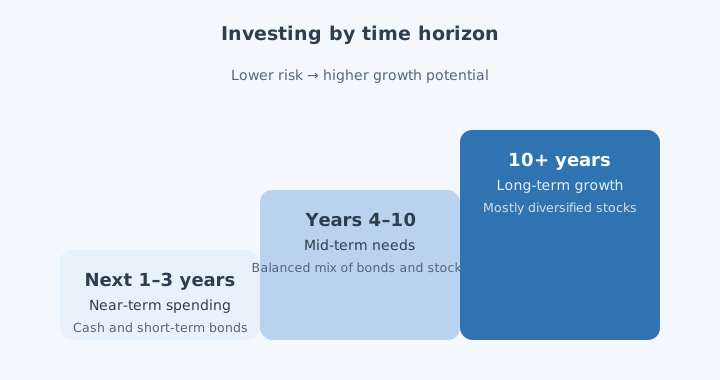
When stocks do well, we refill the near-term segment from gains. When they fall, the near-term money covers your spending so you are not forced to sell investments at a low point. This is how market drops become an expected part of the plan instead of an emergency.
Costs, conflicts, and why independence matters
Costs are one of the few parts of investing you can control. Layered fund expenses, trading costs, and commissions compound against you year after year, the same way returns compound for you. The SEC's investor education site, Investor.gov, has good tools for seeing how fees affect a portfolio over time.
As an independent Registered Investment Advisor we are not tied to a brokerage firm or a proprietary fund family. For investment management we are fee-only: you pay a transparent advisory fee, and we do not receive commissions on the investments we recommend. That keeps the choice of funds about cost and quality.
Diversification, rebalancing, and asset location
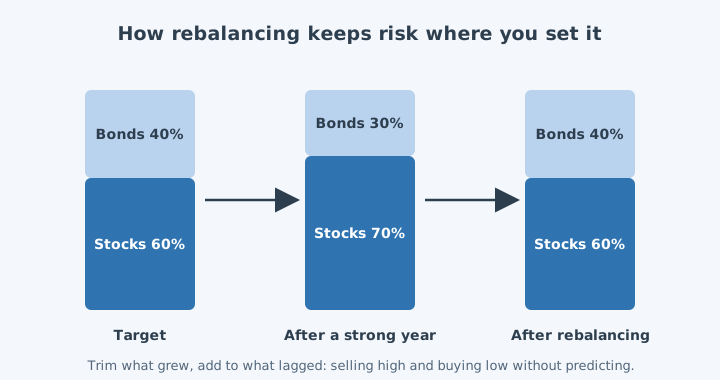
Diversification means spreading money across different types of investments so one bad outcome cannot sink the plan. Rebalancing means periodically bringing the mix back to its targets, which quietly enforces the discipline of trimming what has grown and adding to what has fallen.
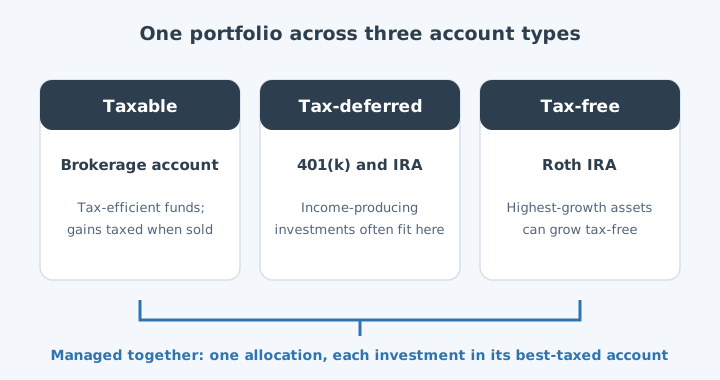
Asset location is the tax-aware piece: holding each investment in the account type where it is taxed most favorably. Income-producing investments often fit best in tax-deferred accounts, while investments with the most growth potential may belong in a Roth, where future growth can be tax-free.
How our investment planning process works
We gather every account, including old 401(k)s and your spouse's plans, so we can see the whole picture. We measure risk tolerance and capacity, design the allocation around your timeline, and explain the reasoning in plain language before anything changes. After implementation we review on a schedule and whenever your life changes, and we rebalance when the mix drifts.
Some assets belong exactly where they are, and we will tell you when leaving an account alone is the right answer. If you would like a second opinion on your current portfolio, a complimentary visit is a good place to start.
Who this is for
You might recognise yourself here
You have accounts scattered across old employers
A 401(k) here, a rollover IRA there, a brokerage account you opened years ago. Nothing is coordinated and you are not sure what you actually own.
You are not sure how much risk you are taking
Most people know their return. Far fewer know how far their portfolio could fall in a bad year — or whether they could live with it.
You suspect you are paying too much
Layered fund fees, trailing commissions, and products sold rather than chosen. Costs are the one part of investing you can control.
What we do
How this works in practice
No jargon, no black box. Here is the actual work.
-
Measure risk tolerance and risk capacity
Tolerance is how you feel about a drop. Capacity is how much of one your plan can actually survive. Both matter, and they are often different.
-
Build the allocation around the plan
Money you need in three years is invested differently from money you will not touch for twenty. The allocation follows the timeline, not a hunch about the market.
-
Choose funds on cost and quality
Independent means we can use low-cost index funds, active managers, or both, without a house list dictating the answer.
-
Coordinate across every account
Your IRA, your Roth, your taxable account, and your spouse's 401(k) are managed as one portfolio, with the right assets in the right place for tax purposes.
-
Rebalance with discipline
We review on a schedule and rebalance when the mix drifts — which is how you end up selling high and buying low without having to predict anything.
How it fits your bigger plan
One piece of a single plan
Investments do not exist for their own sake. The portfolio has one job: fund the income plan without taking more risk than you need to take. When those two are designed together, market drops become an expected part of a plan rather than an emergency.
See the comprehensive plan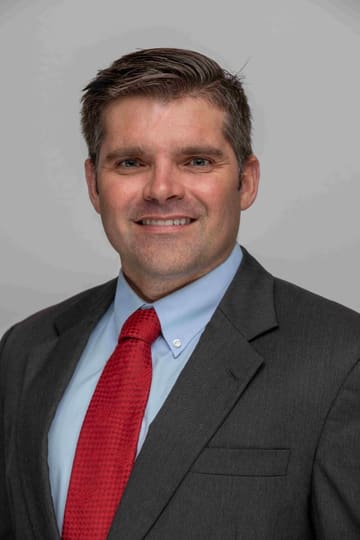
Your planner
Jason French, MBA
Founder and lead advisor of French Capital Management. A disabled combat veteran and former Merrill Lynch and Edward Jones advisor, Jason now works as an independent fiduciary for families in Jacksonville and across Northeast Florida.
Meet JasonQuestions
Common questions about Investment Planning
What does independent and fiduciary actually mean?
Independent means we are not employed by a brokerage firm that manufactures its own products, so there is no house menu we are expected to sell from. Fiduciary means we are legally obligated to act in your best interest — not merely to recommend something that is suitable.
How are you paid?
For investment management we are fee-only: a transparent advisory fee, and no commissions on the investments we recommend. We walk you through the exact fee and what it covers before you sign anything, and it is disclosed in our Form ADV. If you ever buy an insurance product through us, the insurer pays a commission, which we disclose first — and you are never obligated to buy insurance from us.
Will you try to move all of my money?
No. Some assets belong exactly where they are — an old 401(k) with an unusually good institutional fund, for example. We tell you when leaving something alone is the right answer.
What happens when the market drops?
Nothing surprising, which is the point. The allocation is built knowing that drops happen. We rebalance, look for tax-loss harvesting opportunities where they apply, and revisit the plan — not the headlines.
What is the difference between a fee-only and a commission-based advisor?
A fee-only advisor is paid directly by the client, usually a percentage of assets or a flat fee, rather than by commissions on the products they recommend. A commission-based advisor is paid by the company whose product you buy. For investment management we are fee-only; if you ever buy an insurance product through us, the insurer pays a commission, which we disclose first.
Do you use index funds or actively managed funds?
Either or both. Because we are independent, there is no house list: we can use low-cost index funds, active managers where they earn their cost, or a mix, based on what fits your plan.
Related
Other pieces of the plan
Tax Planning
Tax diversification designed to minimize income, capital-gains, and estate taxes over your lifetime.
Healthcare Planning
Medicare decisions, coverage before 65, and a realistic plan for long-term care costs.
Legacy & Estate Planning
Coordinating with your attorney to protect what you have built and pass it on cleanly.
Let's talk about your plan
A relaxed, no-pressure conversation about your goals. Free, about 30 minutes, and you will leave with something useful whether or not we work together.
Veteran-owned · Independent fiduciary · Jacksonville, Florida