
Before you start investing, it pays to check the ground you are building on. Most people approach personal finance by asking where to invest their money. A better first question is whether the foundation beneath that investment is solid.
Before selecting funds, optimizing returns, or worrying about market timing, there are three areas that deserve serious attention: protecting your financial base, understanding the role insurance plays, and knowing the account types available to you. Getting these right early shapes every decision that follows.
Part One
Building Your Financial Base
Think of your financial plan as a structure. The investment portfolio most people focus on is the roof, but without stable walls and a foundation beneath it, even a well-constructed roof is vulnerable. Two elements form that foundation more than any others: a cash reserve for unexpected events, and a clear-eyed approach to existing debt.

Start With an Emergency Fund
An emergency fund exists for one purpose: to prevent a financial disruption from becoming a financial crisis. Without one, an unexpected expense — a job loss, a medical bill, a car repair — forces a difficult choice between taking on high-interest debt or liquidating investments at the wrong time. Either outcome can set back years of progress.
The right size depends on your income stability, household expenses, and personal circumstances. A dual-income household with salaried work sits in a very different position than a single earner working on commission. But the principle is consistent across nearly every financial planning framework: liquid reserves come before investing.
Questions worth answering before you set a target
- How many months of essential expenses — not total spending — would you need to cover?
- How quickly could your household realistically replace lost income?
- Is any part of your income variable, seasonal, or commission-based?
- Do you carry a high deductible on health or homeowners coverage that a single event could trigger?
Know How to Think About Debt
Debt adds another layer of complexity. High-interest debt carries a cost that most investments cannot reliably overcome, which means paying it down is often the more mathematically sound move. Lower-interest debt, such as a mortgage or certain student loans, presents a genuine tradeoff.
High-interest debt
Credit cards and similar balances carry rates that few portfolios beat consistently. Paying them down produces a guaranteed return equal to the interest rate — one of the very few guaranteed returns available anywhere in finance.
Lower-interest debt
Mortgages and some student loans warrant an actual comparison. The return you might earn by investing could exceed the interest you would save by prepaying, but that depends on your rate, tax deductibility, timeline, and risk tolerance. There is no universal answer.
What matters is approaching that decision deliberately rather than by default. Together, a cash reserve and a thoughtful approach to debt create the stability that makes long-term investing viable. Without them, even a sound investment strategy sits on shaky ground.
Part Two
Protecting What You Have Built
Insurance tends to get overlooked in financial planning conversations, but it belongs in the same foundational discussion. The purpose of insurance is straightforward: to protect against financial losses that would be difficult or impossible to recover from on your own. A gap in the right coverage at the wrong moment can undo years of careful saving and investing. Three types come up most often in a comprehensive financial plan.
Life Insurance
Life insurance provides income replacement for the people who depend on you financially. If your income supports a household, a mortgage, or dependents, a coverage gap represents a significant financial risk. The right type and amount depends on your age, income, family situation, and existing assets — and it changes as those things change. Coverage sized around a young family with a new mortgage often looks very different fifteen years later.
Disability Insurance
For most working-age adults, the ability to earn an income is their single largest financial asset, yet relatively few people have adequate protection against losing it. A serious illness or injury that prevents you from working, even temporarily, can derail a financial plan far more severely than a market downturn.
Employer-provided coverage exists in many workplaces but often falls short of fully replacing lost income. Group long-term disability policies typically replace around 60% of base pay, frequently exclude bonuses and commissions, and when the employer pays the premium, the benefit is generally taxable to you when received. That combination can leave a meaningful gap between what you are covered for and what you actually live on.
Long-Term Care Insurance
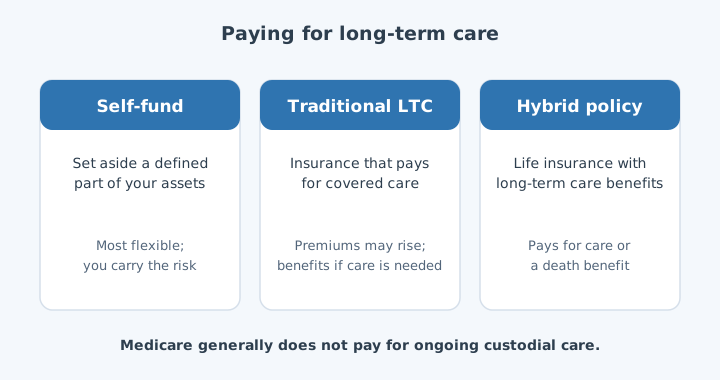
Nursing home care, assisted living, and in-home care are among the largest potential expenses retirees face, and they are not covered by standard health insurance or Medicare in most cases. Medicare pays for short-term skilled nursing following a qualifying hospital stay. It does not pay for ongoing custodial care — help with bathing, dressing, and daily living — which is the kind most people eventually need.
What long-term care actually costs
National median annual costs from the 2025 CareScout Cost of Care Survey:
- $74,400Assisted living community
- $114,975Nursing home, semi-private room
- $129,575Nursing home, private room
- $80,080In-home caregiver, 44 hrs/week at $35/hr
Costs vary widely by region, and these are medians rather than predictions. The point is scale: a few years of care can consume a retirement portfolio that took decades to build.
Planning for this possibility well before it becomes relevant is considerably more cost-effective than addressing it after the fact. Premiums rise sharply with age, and health conditions that emerge in your sixties can make coverage expensive or unavailable entirely.
Reviewing your coverage across these three areas — understanding what you have, what you are missing, and what level of protection makes sense for your situation — is a conversation that belongs early in the planning process, and one worth revisiting as life circumstances change.
Part Three
Understanding Where to Put Your Money
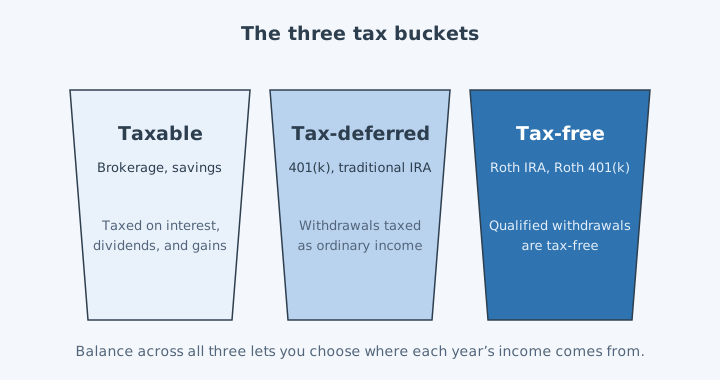
Once a financial base is in place, the next question is not just what to invest in, but where to hold those investments. The type of account you use determines how your contributions are taxed, how your growth is treated, and what rules govern withdrawals. Most investors have access to three broad categories, each with distinct advantages.
Category One
Tax-Deferred
You contribute pre-tax dollars, reducing taxable income today. Growth is tax-deferred, but withdrawals in retirement are taxed as ordinary income. Best suited to people who expect a lower bracket in retirement than during their working years.
Category Two
Tax-Free
You contribute after-tax dollars, growth is tax-free, and qualified withdrawals are not taxed at all. Best suited to people who expect a higher rate later, or who want certainty about what they will owe in retirement.
Category Three
Taxable Brokerage
No special tax treatment, but no restrictions either. No contribution limits, no required withdrawals, no early-access penalties. Important for goals outside the retirement timeline, or once tax-advantaged options are maxed.
How the Common Account Types Compare
| Account Type | 2026 Limit | Contributions | Growth | Withdrawals | Early Penalty |
|---|---|---|---|---|---|
| Traditional 401(k) | $24,500 ($32,500 if 50+) | Pre-tax | Tax-deferred | Ordinary income | 10% before 59½ |
| Roth 401(k) | $24,500 ($32,500 if 50+) | After-tax | Tax-free | Tax-free (qualified) | 10% on earnings before 59½ |
| Traditional IRA | $7,500 ($8,600 if 50+) | Pre-tax (if eligible) | Tax-deferred | Ordinary income | 10% before 59½ |
| Roth IRA | $7,500 ($8,600 if 50+) | After-tax | Tax-free | Tax-free (qualified) | 10% on earnings before 59½ |
| Taxable Brokerage | No limit | After-tax | Taxed annually | Capital gains tax | None |
2026 figures reflect IRS Notice 2025-67. On a phone, swipe the table sideways to see every column.
New this year
Three 2026 Rules Worth Knowing
Several SECURE 2.0 provisions are now in effect, and they change the math for savers over 50.
- The age 60–63 “super catch-up.” If you turn 60, 61, 62, or 63 during the year and your plan allows it, your catch-up contribution is $11,250 instead of $8,000 — a total of $35,750 for the year.
- Mandatory Roth catch-up for higher earners. As of January 1, 2026, if your FICA wages from your plan’s employer exceeded $150,000 in 2025, any catch-up contributions must be made on a Roth basis. The upfront deduction is gone for those dollars. The test looks at wages from a single employer rather than household income, so someone who changed jobs mid-year may land on a different side of the line than expected — and if the plan offers no Roth option at all, affected employees cannot make catch-up contributions.
- The IRA catch-up is now indexed. After sitting at $1,000 for years, it rises to $1,100 for 2026 and will adjust for inflation going forward.
Roth IRA eligibility shifted as well. For 2026, the contribution phase-out runs from $153,000 to $168,000 for single filers and heads of household, and from $242,000 to $252,000 for married couples filing jointly.
Tax Diversification
One concept worth understanding is tax diversification. Just as spreading investments across asset classes reduces exposure to any single market risk, spreading savings across account types reduces exposure to future tax uncertainty. No one knows exactly what tax rates will look like in 20 or 30 years. Holding assets in a mix of pre-tax, after-tax, and taxable accounts gives you flexibility to draw from different sources depending on your tax situation in any given year of retirement.
Sequencing Matters More Than People Expect
The sequencing of how you fund these accounts — which ones you prioritize first and in what proportion — is one of the more nuanced and consequential decisions in financial planning. It depends on your current income, expected retirement income, employer match availability, and long-term goals. It is also one of the areas where working with a financial advisor tends to produce the most tangible benefit.
Where to Go From Here
Understanding these foundations does not require becoming a financial expert. It requires having a clear picture of your current situation and a framework for making deliberate decisions. At French Capital Management, we walk through each of these areas with every client before making any investment recommendations, because a well-built plan starts with the fundamentals, not the portfolio.
Ready to take a more structured approach?
We would welcome the conversation. Schedule a complimentary consultation with Jason French and walk through your foundation before the portfolio.
This material is provided for informational and educational purposes only and does not constitute investment, tax, or legal advice, nor a recommendation to buy or sell any security. Contribution limits, phase-out ranges, and tax rules referenced above reflect IRS guidance for the 2026 tax year and are subject to change. Long-term care cost figures are national medians from the 2025 CareScout Cost of Care Survey and will vary by region and provider.
Individual circumstances differ; consult a qualified tax, legal, or financial professional before acting on any information here. French Capital Management is a registered investment advisor. Advisory services are offered only to clients and prospective clients where French Capital Management and its representatives are properly licensed or exempt from licensure.
For more on the vocabulary of investing, the SEC’s Investor.gov is a free, reliable resource.
How big should an emergency fund be before you start investing?
A common guideline is three to six months of essential expenses, kept in a savings or money market account you can reach quickly. Households with one income, variable pay, or a lot of fixed costs often aim for the higher end. The point is simple: an emergency should never force you to sell investments at a bad time. Once the fund is in place, rebuild it first whenever you use it, before adding new money to your investments.
Next steps before you start investing
Before you start investing, work through the three foundations above in order. Our free budget planner helps you size an emergency fund, our insurance quote page explains the main types of coverage, and our guide to investment basics covers the ideas that come next. If you would like help putting these foundations in place for your own household, your first visit with Jason is complimentary.