

Tax diversification is the answer to a problem most savers do not see coming. Most people spend their working years being told, correctly, to put money in the 401(k). It is good advice. But followed on its own for thirty years, it leaves you with one enormous bucket of money that shares a single feature: every dollar you take out is taxed as ordinary income, at whatever rate applies the year you withdraw it.
That is not a disaster. But it hands the IRS a permanent seat at your retirement table, and there is a better way to sit them down.
The three buckets
Money can live in one of three tax treatments, and the goal of tax diversification is to have meaningful amounts in each:
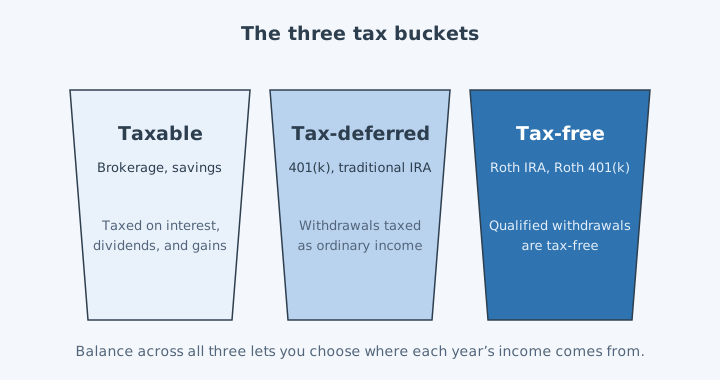
- Tax-deferred — traditional 401(k) and IRA. You deducted the contribution, the money grows untaxed, and every withdrawal is taxed as income. Eventually the government forces withdrawals through required minimum distributions.
- Tax-free — Roth IRA and Roth 401(k). You paid tax on the way in, and everything after that — growth and withdrawals — is tax-free, with no forced distributions during your lifetime.
- Taxable — an ordinary brokerage account. No special treatment going in, but long-term gains are taxed at lower capital-gains rates, and your heirs may receive a valuable step-up in basis.
Why one bucket is a problem
Picture a retiree with everything in a traditional 401(k). Every dollar of spending is a taxable withdrawal. A large unexpected expense — a new roof, a medical bill — means a large taxable withdrawal, potentially pushing them into a higher bracket and even raising their Medicare premiums two years later. They have no way to take money out without a tax consequence, because they only have one lever.
Tax diversification is not about paying less tax this year. It is about having a choice, every year, about where your income comes from — and that choice is worth real money over a retirement.
The window most people miss
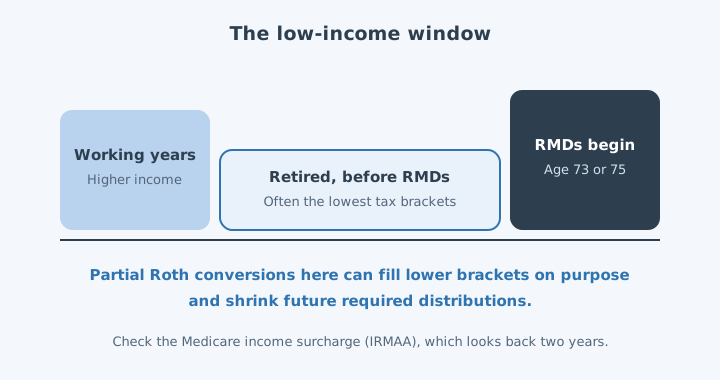
The years between retiring and the start of required minimum distributions are often the lowest-income years of someone’s life. Wages have stopped, but forced withdrawals have not begun. For many people this is the best window they will ever get to convert some traditional money to Roth — paying tax now, at a low rate, to move money into the tax-free bucket and shrink those future forced withdrawals.
Done well, a series of modest conversions across several low-income years can meaningfully lower the tax paid over a lifetime. Done carelessly, a conversion can spill into a higher bracket or bump a Medicare premium. The difference is entirely in the planning.
What this looks like in practice
We are not suggesting you stop using your 401(k) — the upfront deduction is valuable, especially in your peak earning years. The point is to be deliberate: to add Roth contributions where they fit, to keep some money in a plain taxable account for flexibility, and to use those low-income years intentionally. And because none of this is tax advice specific to you, we do it alongside your CPA, so the strategy and the tax return always agree.
Tax diversification in practice: a simple checklist
- Know your mix. List every account and which bucket it belongs to. Many people are surprised how lopsided it is.
- Use Roth options where they fit. Roth 401(k) contributions and Roth IRAs build the tax-free bucket. As of 2024, Roth 401(k)s no longer require distributions during the owner’s lifetime, the same as Roth IRAs.
- Mind the five-year rule. Roth IRA earnings are tax-free once you are 59½ and the account has been open five years. Each conversion also has its own five-year clock for penalty purposes if you are under 59½.
- Keep a taxable account. Flexible money you can reach without income tax on every dollar is valuable before and during retirement.
- Plan the low-income years. Map out the years between retiring and required distributions, which begin at 73 or 75 depending on your birth year.
The IRS summarizes the rules for Roth accounts on its Roth IRAs page.
Frequently asked questions
Is a Roth always better than a traditional account?
No. A traditional account wins when your tax rate is higher today than it will be when you withdraw; a Roth wins when the reverse is true. Because nobody knows future tax rates, holding some of each is the point of tax diversification.
Do Roth conversions make sense after I retire?
Often they make the most sense then, in the years before Social Security and required distributions begin. We model each conversion against your bracket and Medicare premiums, and review it with your CPA.
How do required minimum distributions affect tax diversification?
Required distributions apply to tax-deferred accounts, such as traditional IRAs and 401(k)s, starting at 73 or 75 depending on your birth year. Roth IRAs and ordinary taxable accounts have no required distributions for the owner, so money in those buckets gives you more control over when, and whether, it creates taxable income.
Where should new savings go for better tax diversification?
Start by capturing any employer match in your 401(k), because the match is an immediate return. After that, many savers split new contributions between traditional and Roth accounts based on their current tax bracket, and keep adding to a taxable account for flexibility. The right split changes with your income from year to year, which is why it is worth revisiting annually.
Next steps: building tax diversification into your plan
Tax diversification is easiest to build gradually. List your accounts by bucket, decide where new savings should go, and mark the low-income years when Roth conversions may make sense. Our tax planning work models those decisions with your CPA, and our income planning sets the withdrawal order that uses the buckets well in retirement. A complimentary visit is a good way to see where your own mix stands today.