

This veterans financial checklist exists because leaving service comes with a stack of financial decisions that civilian planning guides simply do not cover — and several of them are close to irreversible. As a veteran who has made these choices personally, here is the checklist I wish every service member had in hand before they transitioned.
1. Decide what to do with the TSP
The Thrift Savings Plan is one of the best retirement vehicles anywhere — rock-bottom costs and solid, simple fund choices. When you leave service you can generally leave the money there, roll it to an IRA, or move it into a new employer’s plan. There is no single right answer. Leaving it in the TSP keeps those low costs; rolling to an IRA opens up more investment options and easier Roth conversions. What you should not do is cash it out — the tax and penalty can take a brutal bite.
2. Understand VA disability compensation
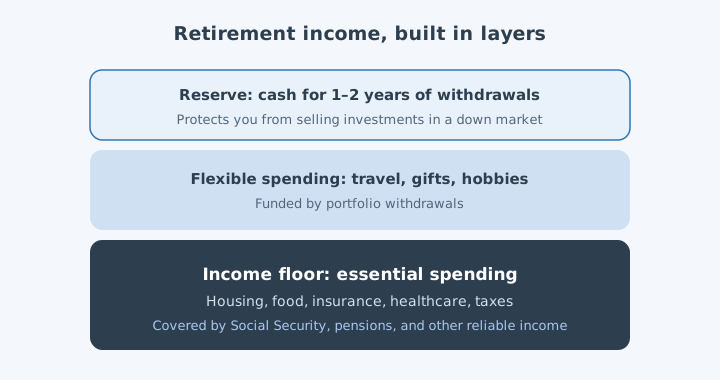
VA disability compensation is tax-free, and it does not reduce your military retirement pay the way it once did for many retirees. If you have a rating, it becomes a guaranteed, inflation-adjusted piece of your income floor — and because it is tax-free, a dollar of it is worth more than a dollar of taxable income. It is worth building your plan around deliberately rather than treating it as a bonus.

Tax-free, inflation-adjusted, and guaranteed for life — VA disability compensation is one of the most valuable income streams a plan can be built on. Treat it accordingly.
3. Take the SBP election seriously
The Survivor Benefit Plan decision at retirement determines whether your pension continues to a surviving spouse — and it is one of the most consequential and least-understood choices you will make. Declining coverage raises your monthly check now, but can leave a spouse with far less if you pass first. It interacts with VA benefits and life insurance in ways that deserve real analysis, not a quick signature at an out-processing desk.
4. Plan the healthcare bridge and the Medicare overlap
TRICARE is a genuine benefit, but it has its own rules, costs, and enrollment steps that change at retirement and again at 65, when it coordinates with Medicare. Missing a Medicare enrollment window can trigger lifelong penalties even if you have TRICARE, so the timing matters. Map it out before each transition rather than after.
5. Convert military skills and gaps into a civilian plan
- Life insurance. SGLI ends after you separate. If people depend on your income, line up replacement coverage before it lapses.
- Emergency fund. Civilian income can be less predictable than a military paycheck. A larger cash buffer smooths the transition.
- New employer benefits. A civilian 401(k) match is free money — capture it from day one.
- State taxes. If you are settling somewhere new, the state tax picture may look very different from your last duty station. Florida, for instance, has no state income tax.
Why this is personal
I served two tours of Operation Enduring Freedom, and French Capital Management is a Service-Disabled Veteran-Owned Business. These are not abstract topics to me — they are decisions I have worked through myself and now help other veterans and their families work through. If you are approaching transition, or already through it and unsure whether you got these right, that is exactly the conversation I am here for.
Your veterans financial checklist, at a glance
- TSP: decide to keep, roll over, or move it; do not cash it out. If you were under the Blended Retirement System, confirm you captured the full government match.
- VA disability: file or review your claim; the compensation is tax-free. See VA.gov disability benefits.
- SBP: make the Survivor Benefit Plan election with your spouse, knowing what each option leaves them.
- Life insurance: SGLI ends after separation. You can convert to Veterans’ Group Life Insurance without proving good health if you apply within 240 days of leaving service (and can apply up to one year and 120 days after). Details are on the VA’s VGLI page.
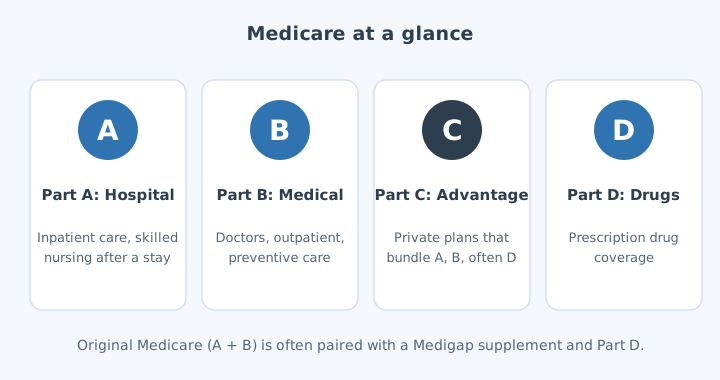
- Healthcare: map TRICARE, VA healthcare, and Medicare. Military retirees who want TRICARE For Life must enroll in Medicare Parts A and B at 65.
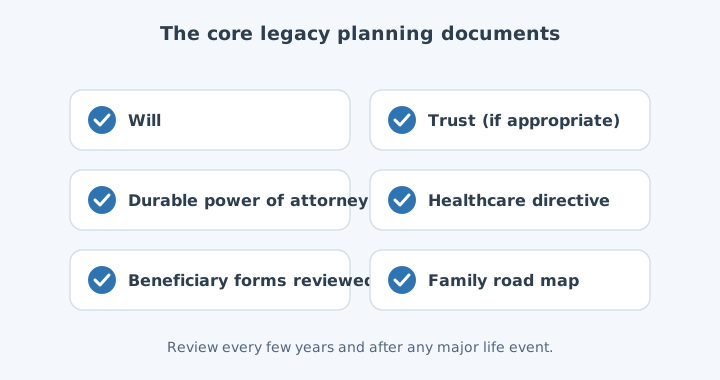
- Estate documents: update your will, powers of attorney, and every beneficiary form after you separate.
You can check your TSP balance and options at TSP.gov.
Frequently asked questions
Is VA disability compensation taxable?
No. VA disability compensation is not subject to federal income tax, which makes it more valuable in a plan than the same amount of taxable income.
Should I roll my TSP into an IRA?
It depends. The TSP’s costs are very low; an IRA offers more investment choices and can make Roth conversions simpler. Compare the two before moving anything, and avoid cashing out.
What does the Survivor Benefit Plan pay?
If you elect full coverage, the Survivor Benefit Plan pays your surviving spouse up to 55% of the base amount you choose, adjusted for inflation, for the rest of their life. You pay a monthly premium from your retired pay for that protection, which is why the election deserves a careful comparison with life insurance.
When should I start working through this checklist?
Ideally a year or more before separation or retirement. Several items, including the Survivor Benefit Plan election, VGLI conversion, and Medicare enrollment for TRICARE For Life, have deadlines or windows that are easy to miss in the busy final months of service.
Next steps with your veterans financial checklist
Work through this veterans financial checklist with your spouse, and keep your decisions in writing. Then connect them to the rest of your plan: income planning builds military retirement pay and VA compensation into your income floor, and healthcare planning maps TRICARE, VA care, and Medicare. You can read more about Jason’s own service and background on the about page, and a complimentary visit is always open to veterans and their families.